
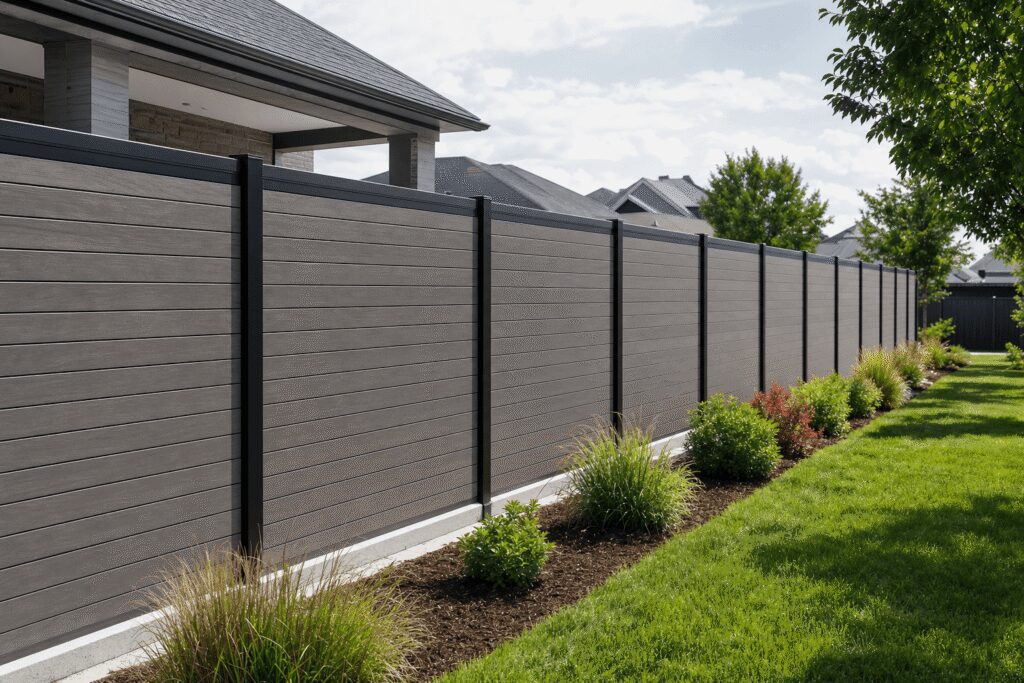
A composite fence is a modern fencing system built from engineered panels that combine wood fibers and recycled plastic, paired with durable aluminum or steel posts. Unlike traditional wood fencing that requires regular staining and sealing, or vinyl that can crack in extreme cold, composite fencing delivers the natural wood-grain appearance many homeowners prefer with significantly reduced maintenance demands. For Greater Montreal properties facing harsh freeze-thaw cycles, understanding how composite materials perform and what installation considerations apply before you request a quote helps ensure your fence investment delivers the durability and appearance you expect.
This guide explains what composite fencing is made from, how it compares to wood and vinyl alternatives, how it performs in Quebec’s seasonal extremes, and what installation requirements apply to ensure long-term performance across Montreal, Laval, the West Island, and North Shore communities.
Quick Answer
A composite fence is made from wood fibers and recycled plastic molded into fence boards, combined with aluminum posts. It resists rot, insects, and moisture while requiring minimal maintenance compared to wood fencing.
What Is a Composite Fence? Definition and Material Composition
Composite fencing consists of fence panels manufactured from a blend of wood fibers and recycled plastic polymers, typically mounted between aluminum posts. The wood fibers provide natural texture and appearance, while the plastic component binds the material together and provides moisture resistance and structural stability.
The manufacturing process combines these materials under heat and pressure, creating dense boards that resist warping, splitting, and rot. Most composite fence panels feature a wood-grain texture on the visible surface that mimics natural wood without the maintenance requirements. The plastic content typically ranges from 40% to 60% of the total composition, with the remainder consisting of wood fibers and small amounts of bonding agents or UV stabilizers.
Unlike solid wood boards that can absorb moisture and expand or contract significantly with temperature changes, composite boards maintain more consistent dimensions across seasons. The material does not require painting or staining, and it will not splinter the way pressure-treated wood can after several years of weathering.
Aluminum posts anchor composite fence systems to the ground and provide the structural frame that holds panels in place. These posts resist rust better than steel and remain stable in freeze-thaw conditions without the rot concerns that affect wood posts. Post installation depth and concrete footing requirements remain critical to fence stability, particularly in Quebec where frost penetration reaches significant depths during winter months.
Key Takeaways
- Understand composite fences combine wood fibers and recycled plastic for durability
- Expect aluminum posts to provide rust-resistant structural support for composite panels
- Plan for deeper post footings in Quebec to handle frost line depths
- Choose composite materials when low maintenance matters more than upfront cost
- Book an onsite visit to verify site conditions before finalizing fence layout
Key Advantages and Limitations of Composite Fencing
Composite fencing offers distinct performance advantages over traditional wood while introducing different cost and installation considerations. Understanding both benefits and limitations helps you determine whether composite materials align with your property needs and budget expectations.
Benefits: Durability, Low Maintenance, and Aesthetic Appeal
Composite fence materials resist the primary failure modes that affect wood fencing. The plastic content prevents moisture absorption that causes wood to rot, warp, or support fungal growth. Insects, including carpenter ants and termites, do not damage composite boards the way they attack wood posts and rails. Maintenance requirements remain minimal compared to wood. Composite fencing does not require annual staining, sealing, or painting to maintain appearance and protect against weathering. Cleaning typically involves hosing down panels or scrubbing with mild soap and water to remove accumulated dirt, pollen, or mildew surface growth.
Color consistency holds better than wood stain. While composite materials will fade slightly during the first year of UV exposure, they reach a stable color that changes little afterward. Many composite fence manufacturers offer materials in several color options, including various shades of brown, gray, and black that coordinate with different home exterior finishes.
Drawbacks: Cost and Installation Considerations
Initial composite fence cost runs higher than wood fencing, typically 40% to 80% more for materials alone. Composite boards are denser and heavier than dimensional lumber, which affects handling during installation. Cutting composite materials requires specific blade types to avoid melting the plastic content or creating rough edges. Thermal expansion affects composite materials more than wood. As temperatures shift between summer heat and winter cold, composite boards expand and contract. Proper installation requires leaving appropriate gaps between board ends and posts to accommodate this movement without buckling.
Expert Tip from Fidar Clôture
When verifying measurements during onsite visits, we check for grade changes along the fence line that affect panel positioning. Composite panels cannot be easily trimmed on-site the way wood can, so confirming ground levels before ordering materials prevents gaps under panels or awkward cuts during installation.
Composite Fence Performance in Quebec’s Climate
Quebec’s seasonal extremes test fence materials in ways that milder climates do not. Understanding how composite fencing responds to freeze-thaw cycles, temperature fluctuations, and installation requirements specific to frost penetration helps set realistic performance expectations.
Freeze-Thaw Resistance and Temperature Extremes
Composite materials handle freeze-thaw cycles better than many alternatives because they do not absorb significant moisture. When water enters wood grain and freezes, it expands and creates internal pressure that splits fibers and opens cracks. Composite boards resist moisture penetration, which limits freeze-thaw damage to surface-level effects rather than structural degradation. Temperature extremes affect composite fence appearance and dimensions more than structural integrity. As temperatures drop well below freezing during Montreal winters, composite materials contract slightly. When summer heat arrives, they expand. This dimensional change remains predictable and manageable through proper installation techniques that accommodate movement.
Installation Requirements: Frost Lines and Concrete Footings
Quebec frost line depths require posts to extend significantly deeper than mild-climate installations. Frost penetration commonly reaches 4 to 5 feet below grade in the Montreal region. Posts must extend below this depth to prevent frost heave, where freezing ground lifts posts upward and shifts fence alignment. Concrete footings anchor posts below the frost line and distribute weight across stable soil. The footing diameter and depth both affect stability. Properly sized footings poured to adequate depth prevent movement and keep fence lines straight over decades.
| Installation Component | Quebec Requirement | Why It Matters |
|---|---|---|
| Post Depth | Minimum 4-5 feet below grade | Extends below frost line to prevent heave |
| Concrete Footing Diameter | 10-12 inches typical | Distributes load across stable soil |
| Expansion Gap | 1/8 to 1/4 inch between boards | Accommodates thermal expansion in 60°C temperature range |
| Fastener Type | Stainless or coated steel | Resists corrosion in moisture and freeze-thaw exposure |
FIDAR CLÔTURE
Planning a new fence?
Get a fast online estimate, then confirm the project details with our team before installation.
Composite vs. Wood and Vinyl: How They Compare
Choosing between composite, wood, and vinyl fencing requires understanding how each material performs across cost, maintenance, appearance, and lifespan factors.
| Factor | Composite Fence | Wood Fence | Vinyl Fence |
|---|---|---|---|
| Initial Cost | Higher upfront investment | Lowest initial cost | Moderate to high cost |
| Maintenance | Minimal, no staining required | Regular staining every 2-3 years | Occasional cleaning only |
| Appearance | Wood-grain texture, stable color | Natural wood, fades without stain | Smooth finish, limited texture |
| Cold Climate Performance | Resists freeze-thaw damage | Prone to splitting and rot | Can crack in extreme cold |
| Moisture Resistance | High, does not absorb water | Requires treatment to resist rot | High, non-porous surface |
Wood fencing offers the lowest upfront cost and the most traditional appearance. Pressure-treated lumber provides basic rot resistance when properly maintained, but requires regular staining or sealing to preserve appearance and extend lifespan. In Quebec’s climate, wood fences that are not maintained consistently begin showing deterioration within 5 to 8 years. Over a 20-year period, these maintenance expenses can approach or exceed the initial cost premium of composite fencing.
Vinyl fencing eliminates maintenance requirements similar to composite but offers different aesthetic and performance characteristics. Vinyl panels provide a smooth, uniform appearance rather than wood-grain texture. In extreme cold, vinyl can become brittle and crack under impact, particularly older formulations without adequate cold-weather additives.
Composite fencing splits the difference between wood’s natural appearance and vinyl’s low maintenance. The wood-fiber content creates texture that resembles real wood more closely than vinyl’s smooth finish, while the plastic component provides moisture resistance and eliminates the rot and insect concerns that affect wood. For homeowners who want wood appearance without wood maintenance, composite delivers this combination at a cost premium that diminishes over time as maintenance savings accumulate.
Composite Fence Gate Options and Hardware Selection
Gate selection represents a critical decision point for composite fence projects. The increased weight of composite panels compared to wood requires different hardware considerations and affects available gate sizes and configurations.
Standard composite gate widths typically range from 3 feet for pedestrian gates to 8 feet for double-gate vehicle access. Single gates wider than 4 feet require heavy-duty hinges and may benefit from diagonal bracing or wheel support to prevent sagging over time. Many manufacturers produce pre-engineered gate frames designed specifically for composite panels, which ensures proper weight distribution and movement accommodation as temperatures change.
Hardware selection matters significantly more for composite gates than wood. Standard residential gate hinges designed for lightweight wood gates cannot adequately support the weight of composite panels. Heavy-duty galvanized steel or stainless steel hinges rated for the specific gate weight prevent sagging and ensure smooth operation through Quebec’s freeze-thaw cycles. Latches must similarly be upgraded to handle the panel weight and thermal movement without binding or failing to secure properly. In cold climates, stainless steel hardware resists corrosion better than standard coated hardware, maintaining smooth operation even after years of moisture exposure and temperature cycling.
Gate posts require reinforcement beyond standard fence posts. The weight of composite gate panels combined with the stress from repeated opening and closing creates additional load on gate posts. Larger diameter posts, deeper footings, or reinforced concrete installations prevent gate posts from leaning or shifting over time. For double gates, a center drop rod or ground-level latch provides additional stability when gates are closed.
Integrating composite gates with existing fence lines requires careful planning. When connecting new composite sections to existing wood fences or vinyl fences, transition posts must accommodate different panel attachment methods and account for different thermal expansion rates. Fidar Clôture evaluates these connections during onsite visits to ensure structural compatibility and proper appearance alignment.
Montreal Municipal Bylaws and Installation Requirements
Installing a fence in Greater Montreal requires understanding municipal regulations that govern fence height, setbacks, shared boundaries, and permit requirements. These rules vary by municipality and affect installation planning.
Fence height limits are commonly set at 6 feet for backyard fences and 4 feet for front yard fences across Montreal, Laval, and surrounding municipalities. However, specific limits vary by zone and proximity to streets or corners. Fences near intersections often require reduced heights or setbacks to maintain sight lines for traffic safety. Checking your specific municipal bylaws before finalizing fence height prevents compliance issues.
Setback requirements establish minimum distances between fences and property lines, sidewalks, or streets. While many residential fences can be installed directly on the property line when shared with a neighbor, front yard fences and corner lots often face setback requirements that position the fence several feet inside the property boundary. These requirements affect available yard space and must be verified during project planning.
Shared boundary fences between neighbors require consent from both property owners under Quebec regulations. When a fence sits directly on the property line, both neighbors share responsibility for maintenance and costs unless prior agreements establish different arrangements. Obtaining neighbor consent before installation prevents disputes and ensures the fence location complies with both properties’ requirements. Written documentation of neighbor agreement protects both parties and clarifies long-term responsibilities.
A certificate of location provides legal documentation of property boundaries, structures, and easements. This survey document proves essential when installing fences on or near property lines, particularly for shared boundary installations. The certificate verifies exact property line locations and identifies any servitudes or restrictions that affect fence placement. While not always legally required for fence installation, obtaining an updated certificate of location before major fence projects prevents boundary disputes and ensures compliance with setback requirements. For properties where boundary markers have been removed or where lot lines follow irregular patterns, this documentation becomes critical.
Permit requirements vary significantly by municipality and fence location. Many residential backyard fence installations under 6 feet do not require permits in Montreal and Laval, but front yard fences, corner lot fences, and installations in heritage districts often trigger permit requirements. Contacting your municipal planning or urban development office before installation clarifies whether permits are needed and what documentation must be submitted. Installing a fence without required permits can result in removal orders or fines.
Frequently Asked Questions
What is a composite fence made of?
A composite fence is made from a blend of wood fibers and recycled plastic polymers molded under heat and pressure into fence boards. Aluminum posts anchor the panels and provide structural support. The typical composition ranges from 40% to 60% plastic content with the remainder consisting of wood fibers and UV stabilizers.
How long does a composite fence last in Quebec’s climate?
Composite fencing typically performs well for decades when properly installed with adequate post depth and drainage. The material resists rot, insect damage, and moisture absorption that limit wood fence lifespan. Posts installed below the frost line and proper expansion gaps during installation remain critical factors for long-term performance through freeze-thaw cycles.
Is composite fencing more expensive than wood fencing?
Yes, composite fencing costs 40% to 80% more upfront than wood fencing for materials. However, composite requires minimal maintenance while wood needs staining every 2-3 years. Over 15 to 20 years, accumulated wood maintenance costs narrow the total ownership cost gap significantly.
Does composite fencing require maintenance, or is it truly maintenance-free?
Composite fencing is low-maintenance but not maintenance-free. It does not require staining, sealing, or painting like wood. Maintenance involves occasional cleaning with water and mild soap to remove dirt and surface mildew. Fasteners and gate hardware should be checked periodically to ensure tightness.
Can composite fencing withstand Montreal’s harsh winters and freeze-thaw cycles?
Yes, composite fencing resists freeze-thaw damage better than wood because it does not absorb significant moisture. The material expands and contracts with temperature changes, but proper installation with adequate expansion gaps accommodates this movement. Posts installed below the 4-5 foot frost line with concrete footings prevent heave and maintain fence stability through winter cycles.
Ready to Install Your Composite Fence?
Composite fencing delivers the natural wood appearance many Greater Montreal homeowners prefer with durability and low maintenance that wood cannot match. Understanding how composite materials perform through Quebec’s freeze-thaw cycles, what installation requirements apply to ensure long-term stability, and how costs compare to wood and vinyl alternatives helps you make an informed decision for your property. Fidar Clôture specializes in professional composite fence installation across Montreal, the West Island, Laval, and North Shore communities, with expertise in Quebec-specific requirements including frost line depths, drainage considerations, and municipal regulations.
Whether you are replacing an aging wood fence or installing a new privacy fence, the first step is getting accurate measurements and site assessment. Request an online quote to receive a preliminary estimate based on your project scope, then book a free onsite visit to verify measurements, confirm gate locations, and address site-specific conditions before installation begins. Our team provides clear communication throughout the process, from initial quote through final installation and cleanup, ensuring your composite fence delivers the performance and appearance you expect for decades to come.\n
Related guide: Is Composite Fencing Cheaper Than Wood? A Montreal Cost Comparison
