
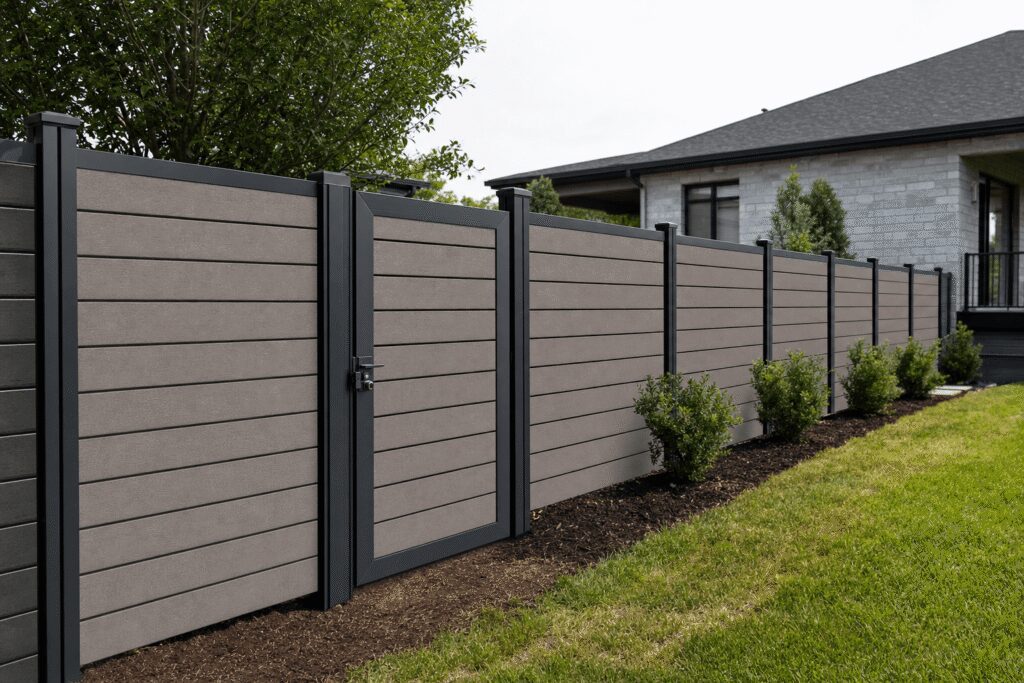
Homeowners researching composite fencing often wonder if they can repurpose composite decking boards instead of purchasing purpose-built fence panels. While both materials share similar WPC (Wood Plastic Composite) construction, can composite decking be used for fencing effectively, or do significant structural and performance differences make this approach problematic?
This article explains the critical differences between composite decking boards and composite fence panels, covering span limitations, orientation requirements, moisture resistance, and structural performance. You will understand why purpose-built composite fencing systems deliver better results, how Quebec freeze-thaw cycles affect material selection, and what Greater Montreal property owners need to know about installation requirements and municipal regulations.
Quick Answer
Composite decking boards can technically be used for fencing, but they are not designed for this application and perform poorly as fence materials due to span limitations, sagging concerns, and improper moisture orientation compared to purpose-built composite fence panels engineered specifically for vertical applications.
Can Composite Decking Be Used for Fencing? Understanding the Key Differences
Composite decking boards and composite fence panels are both manufactured from WPC materials combining wood fiber and recycled plastic. However, the engineering specifications, structural reinforcement patterns, and intended load distributions differ significantly between these two product categories.
Decking boards are designed to support foot traffic and furniture weight from above, distributed across closely spaced joists typically positioned every 16 inches. The internal ribbing structure runs perpendicular to expected loads, and the material density prioritizes compression resistance over lateral span capacity.
Composite fence panels are engineered for horizontal or vertical installation spanning between posts positioned 72 to 96 inches apart. The reinforcement patterns account for wind load, lateral deflection, and cantilever stresses that differ completely from decking applications.
During onsite visits across Montreal, Laval, and the West Island, our team regularly encounters homeowners who purchased composite decking boards thinking they could save money by using them for fence construction. The structural performance issues become apparent within the first season as boards begin to sag between posts.
Key Takeaways
- Choose purpose-built composite fence panels over decking boards for proper span support.
- Expect sagging issues when decking boards span more than 48 inches between posts.
- Verify municipal fence height and setback requirements before ordering materials or installation.
- Select co-extruded WPC fencing for superior moisture resistance in Quebec freeze-thaw conditions.
- Book an onsite assessment to confirm proper material selection and layout planning.
Why Composite Decking Boards Are Not Ideal for Fence Applications
Several structural and performance characteristics make composite decking boards unsuitable for fence construction, even when post spacing is reduced to compensate for span limitations. Understanding these differences helps property owners make informed decisions about material selection.
Span Limitations and Structural Sagging Concerns
Composite decking boards are rated for maximum joist spans between 12 and 16 inches depending on board thickness and profile design. When these same boards are installed horizontally between fence posts spaced 72 to 96 inches apart, the unsupported span exceeds engineering specifications by a factor of four to six.
The result is progressive sagging that worsens over time as temperature fluctuations cause material expansion and contraction. Even when homeowners add mid-span blocking or reduce post spacing to 48 inches, decking boards still exhibit noticeable deflection under wind load or when leaned against.
Purpose-built composite fence boards incorporate denser core material and reinforcement patterns specifically engineered to span 72 inches or more without sagging. The structural profile accounts for lateral loads rather than vertical compression. Maximum span between posts for composite fence boards ranges from 72 to 96 inches based on panel height, board profile thickness, and local wind exposure conditions.
Moisture Resistance and Orientation Differences
Composite decking boards are designed for horizontal installation where any absorbed moisture drains downward through the board structure. The top surface typically features a protective cap layer or textured finish that sheds water away from the core material.
When installed vertically as fence boards, moisture absorption patterns change completely. Water can wick upward through exposed end grain at the bottom of each board, and the protective surface treatment may be oriented incorrectly for vertical applications.
Quebec freeze-thaw cycles compound these moisture concerns. Water absorbed into improperly oriented composite material can freeze, expand, and cause internal structural damage that manifests as surface cracking or delamination after several seasonal cycles. Purpose-built composite fence panels use co-extruded manufacturing processes that encapsulate the entire board profile with a protective polymer shell.
When assessing existing fences built with decking boards, we find the most severe sagging occurs on north-facing sections where temperature swings between direct sun and shade cause accelerated expansion cycles throughout the day.
Horizontal Versus Vertical Board Orientation: Structural Considerations
Board orientation significantly affects structural performance, installation requirements, and support spacing for composite fence systems. Both horizontal and vertical orientations offer distinct advantages depending on design preferences and site conditions.
Horizontal board orientation creates contemporary privacy fence designs where boards span between vertical posts. This configuration requires posts spaced 72 to 96 inches apart with purpose-built fence boards engineered for these span distances. Vertical board orientation installs boards running from top rail to bottom rail with horizontal rails providing intermediate support, typically requiring fewer specialized components.
| Orientation | Post Spacing | Support Requirements | Water Drainage |
|---|---|---|---|
| Horizontal Boards | 72 to 96 inches | Purpose-built fence panels rated for span | Requires drainage gaps between boards |
| Vertical Boards | 96 to 120 inches | Top and bottom rails with intermediate support | Natural downward drainage along board length |
Purpose-Built Composite Fencing Systems: Benefits and Performance
Composite fence systems engineered specifically for fence applications deliver measurable performance advantages in structural stability, weather resistance, and maintenance requirements. These purpose-built materials address the unique demands of vertical fence construction.
Durability and Weather Resistance in Quebec Climate
Quebec’s seasonal temperature swings from minus 30°C winter lows to plus 30°C summer highs create extreme expansion and contraction cycles. Freeze-thaw transitions occur dozens of times per season across Greater Montreal, testing material durability more severely than moderate climates.
Purpose-built composite fencing incorporates design features that accommodate thermal movement without structural failure. Co-extruded WPC fence boards feature a protective polymer shell bonded to the core material during manufacturing. This encapsulation prevents moisture infiltration that would otherwise freeze, expand, and damage internal structure during Quebec winter conditions.
UV stabilizers added to the polymer cap layer prevent color fading and surface degradation from intense summer sun exposure. Properties with south or west-facing fence sections experience the highest UV load, making stabilized materials essential for consistent appearance over time.
Low Maintenance Requirements and Long-Term Value
Composite fence panels eliminate the annual maintenance cycle required for wood fencing, including staining, sealing, and treatment against rot or insect damage. The non-porous surface resists mold and mildew growth even in shaded moisture-prone areas common along North Shore properties.
Cleaning composite fencing requires only periodic washing with water and mild soap to remove accumulated dirt or pollen. The material does not splinter, warp, or split like wood alternatives, reducing long-term repair costs.
When evaluating total ownership costs over a 15-year period, composite fencing reaches cost parity with wood alternatives by year 3 to 5 when accounting for annual staining costs averaging $800 to $1,200 per 100 linear feet, repair material expenses of $200 to $400 per year, and labor time valued at $30 to $50 per hour for 8 to 12 hours of annual maintenance work.
Planning a new fence?
Get a fast online estimate, then confirm the project details with our team before installation.
Composite Fence Installation Considerations in Greater Montreal
Successful composite fence installation in Greater Montreal requires attention to municipal regulations, proper foundation methods for Quebec soil conditions, and installation techniques that accommodate seasonal ground movement.
Municipal Regulations and Property Requirements
Municipal fence bylaws vary significantly across Greater Montreal communities. Montreal boroughs typically limit rear yard fences to 72 inches and front yard fences to 48 inches, with setback requirements of 2 feet from sidewalks and property lines. Laval enforces similar height restrictions but requires 5-foot setbacks from corner lot intersections to maintain sight lines.
West Island communities including Pointe-Claire, Dollard-des-Ormeaux, and Beaconsfield maintain separate bylaws, with some municipalities requiring building permits for fences exceeding 60 inches in height. North Shore towns such as Rosemere and Boisbriand enforce strict setback requirements ranging from 3 to 6 feet from front property lines.
Property line fencing requires either written neighbor consent or verification that the fence location remains entirely on the installing property owner’s land. Survey stakes or property pins establish legal boundaries. Corner lot properties face additional restrictions on fence placement near intersections to maintain sight line clearances, typically extending 15 to 20 feet from the property corner depending on local traffic bylaws.
Foundation and Post Installation Requirements
Foundation requirements for composite fencing in Quebec must account for frost depth and seasonal ground movement. Post footings extend below the frost line, typically 48 to 54 inches deep across Greater Montreal, to prevent heaving during freeze-thaw transitions.
Aluminum posts paired with composite fence panels eliminate rust concerns and provide consistent structural support without the rot issues that affect wood posts. The aluminum material conducts temperature changes more rapidly than wood, requiring proper footing depth to maintain stability as surrounding soil freezes and thaws. Concrete footings should cure for 48 to 72 hours before panel installation begins to ensure proper structural integrity.
Gate Integration and Hardware Compatibility
Gate installation with composite fencing systems requires hardware specifically rated for the panel weight and expected usage frequency. Standard residential gates cycle 5 to 10 times daily, while gates providing primary access to pool areas or side yards experience heavier use requiring commercial-grade hinges and latches.
Composite fence manufacturers design gate frames that integrate with panel systems using matching materials and color profiles. These purpose-built gate frames provide structural support for hinges and latches while maintaining visual consistency with adjacent fence sections.
Hardware compatibility varies between composite fence systems. Self-closing hinges, magnetic latches, and lockable gate hardware must mount securely to composite or aluminum gate frames without causing stress concentrations that lead to cracking. Stainless steel or powder-coated aluminum hardware resists corrosion in Quebec weather conditions.
Gate width affects the required frame reinforcement and hinge capacity. Single gates up to 48 inches wide typically require two heavy-duty hinges rated for 150 pounds, while wider gates or double gate configurations need additional support posts and three-hinge systems to prevent sagging over time. Installation methods include through-bolt mounting for maximum holding strength and adjustable hinge plates that accommodate seasonal ground movement and allow for long-term alignment maintenance.
We verify final property line locations and municipal setback requirements during the onsite visit, checking for underground utilities, grade changes, and site access that affect installation timing and post placement before confirming the project scope.
Frequently Asked Questions
Can you use composite decking boards for fencing?
Composite decking boards can technically be installed as fence materials, but they are not engineered for fence applications and will sag when spanning typical fence post distances of 72 to 96 inches. Decking boards are designed to support vertical loads across 12 to 16 inch joist spacing, not lateral wind loads over longer unsupported spans required for fencing.
What is the difference between composite decking and composite fencing?
Composite decking is engineered for horizontal installation supporting foot traffic across closely spaced joists, while composite fencing is designed for vertical or horizontal installation spanning 72 to 96 inches between posts under lateral wind load. Fence panels feature different internal reinforcement patterns, higher span capacity ratings, and complete polymer encapsulation for moisture protection in vertical orientations.
Will composite fencing sag or warp over time?
No, purpose-built composite fence panels maintain structural stability without sagging when installed according to manufacturer specifications with proper post spacing and foundation depth. Composite decking boards repurposed for fence applications will sag progressively as temperature cycles cause material expansion and deflection across unsupported spans exceeding their engineering ratings.
How does composite fencing hold up in Quebec freeze-thaw cycles?
Co-extruded composite fencing with complete polymer shell encapsulation resists moisture infiltration that causes freeze-thaw damage in Quebec climate conditions. The protective cap layer prevents water absorption into the core material, eliminating internal expansion and cracking during frequent freeze-thaw transitions typical across Greater Montreal.
What is the maximum span between posts for composite fence boards?
Purpose-built composite fence panels typically span 72 to 96 inches between posts depending on panel height, board profile, and wind exposure conditions. Composite decking boards used for fencing should not span more than 48 inches between supports and will still exhibit noticeable deflection at this reduced spacing. Manufacturer specifications provide exact span capacity based on panel configuration and local wind load requirements.
Make the Right Material Choice for Your Montreal Composite Fence
Composite decking boards and purpose-built composite fence panels serve fundamentally different applications despite sharing similar material composition. The span limitations, structural reinforcement patterns, and moisture orientation requirements make decking boards unsuitable for fence construction regardless of cost savings or material availability.
Fidar Clôture specializes in professional composite fence installation across Montreal, Laval, West Island, and North Shore communities, helping property owners select appropriate materials and verify project requirements during the free onsite visit. Request an online quote to receive preliminary project pricing, then book a free onsite assessment to confirm measurements, municipal requirements, and installation details before your project begins.
